
January 7, 2026
Microservices architecture has become the dominant design pattern for scalable enterprise applications. This comprehensive guide presents 30 essential interview questions covering fundamental concepts, design patterns, communication strategies, deployment practices, and troubleshooting techniques that technical interviewers expect candidates to master.
Technical interviews can be overwhelming, but you do not have to face them alone. WiseWhisper AI provides real-time answer suggestions during your interview, helping you articulate complex architectural concepts with confidence. Start practicing for free today.
Fundamental Microservices Concepts
1. What are microservices, and how do they differ from monolithic architecture?
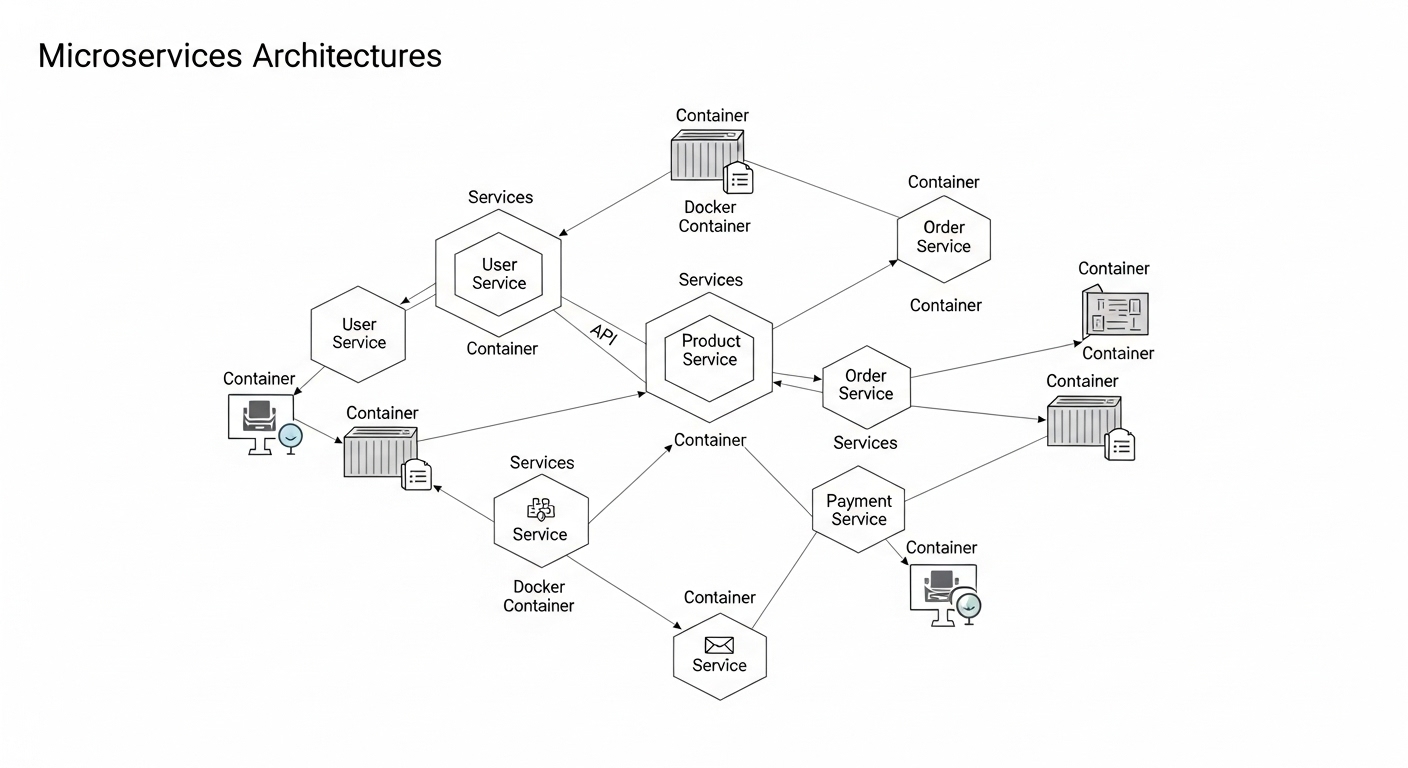
Answer: Microservices is an architectural style that structures an application as a collection of small, autonomous services modeled around a business domain. Each microservice runs in its own process and communicates via lightweight mechanisms (typically HTTP/REST APIs or message queues).
Key differences from monolithic architecture:
- Deployment: Microservices deploy independently; monoliths deploy as single units
- Scalability: Individual services scale independently vs. scaling entire application
- Technology: Each microservice can use different tech stacks; monoliths use unified stack
- Failure Isolation: One service failure does not crash entire system in microservices
- Team Structure: Small, cross-functional teams own services vs. large teams managing entire codebase
2. What are the main advantages and disadvantages of microservices?
Answer:
Advantages:
- Independent deployment and faster release cycles
- Technology diversity—choose best tools for each service
- Better fault isolation and system resilience
- Easier to understand and maintain smaller codebases
- Scalability—scale only services that need it
Disadvantages:
- Increased operational complexity (monitoring, deployment, networking)
- Distributed system challenges (network latency, data consistency)
- Difficult to test end-to-end workflows
- Data management across services becomes complex
- Requires strong DevOps culture and infrastructure automation
3. What is the Database-per-Service pattern, and why is it important?
Answer: The Database-per-Service pattern means each microservice owns its private database that other services cannot access directly. Services interact only through well-defined APIs.
Why it matters:
- Ensures loose coupling—services remain independent
- Allows each service to choose optimal database technology
- Prevents unintended dependencies through direct database access
- Enables independent scaling and schema evolution
- Challenge: Requires distributed transaction management and eventual consistency
Inter-Service Communication
4. What are the main communication patterns between microservices?
Answer: Two primary communication styles exist:
1. Synchronous Communication (Request-Response):
- REST/HTTP APIs—most common, simple, stateless
- gRPC—high performance, binary protocol, strong typing
- GraphQL—flexible data querying, reduces over-fetching
- Use when: Client needs immediate response
2. Asynchronous Communication (Event-Driven):
- Message Queues (RabbitMQ, AWS SQS)—point-to-point delivery
- Event Streams (Kafka, AWS Kinesis)—publish-subscribe, event log
- Use when: Fire-and-forget operations, decoupling services, high throughput needs
5. How does an API Gateway work, and why use one?
Answer: An API Gateway is a server that acts as a single entry point for clients into a microservices architecture. It routes requests to appropriate services, aggregates responses, and handles cross-cutting concerns.
Key functions:
- Request routing and composition (aggregating multiple service calls)
- Authentication and authorization enforcement
- Rate limiting and throttling
- Protocol translation (HTTP to gRPC, REST to message queue)
- Caching and response transformation
- Popular examples: Kong, AWS API Gateway, Azure API Management, Netflix Zuul
6. Explain the Service Discovery pattern.
Answer: Service Discovery allows services to find and communicate with each other dynamically without hard-coded addresses. Essential in cloud environments where service instances scale up/down and IPs change frequently.
Two main patterns:
- Client-Side Discovery: Client queries service registry (Consul, Eureka, etcd) and performs load balancing
- Server-Side Discovery: Load balancer queries registry and routes requests (Kubernetes Services, AWS ELB)
Design Patterns and Best Practices
7. What is the Circuit Breaker pattern?
Answer: Circuit Breaker prevents a service from repeatedly trying to execute an operation likely to fail, allowing it to fail fast and recover gracefully.
States:
- Closed: Normal operation, requests pass through
- Open: Failures exceed threshold, requests fail immediately without calling service
- Half-Open: After timeout, limited requests test if service recovered
Example libraries: Netflix Hystrix, Resilience4j, Polly (.NET)
8. Describe the Saga pattern for distributed transactions.
Answer: A Saga is a sequence of local transactions where each transaction updates data within a single service. If one step fails, compensating transactions undo previous changes.
Two coordination approaches:
- Choreography: Services publish events, others listen and react (decentralized, complex to debug)
- Orchestration: Central orchestrator tells services what to do (centralized, easier to monitor)
Example: E-commerce order requiring payment, inventory, shipping coordination
9. What is the Strangler Fig pattern for migration?
Answer: The Strangler Fig pattern incrementally replaces legacy monolithic systems by gradually building new microservices around the edges and routing traffic away from old functionality.
Steps:
- Identify bounded context in monolith to extract
- Build new microservice implementing same functionality
- Route traffic through facade/proxy to new service
- Monitor and validate new service behavior
- Remove old code from monolith once confident
- Repeat until monolith fully decomposed
10. What is the CQRS (Command Query Responsibility Segregation) pattern?
Answer: CQRS separates read (query) and write (command) operations into different models. Commands modify state; queries retrieve data without side effects.
Benefits:
- Optimize read and write databases independently (e.g., PostgreSQL for writes, Elasticsearch for reads)
- Scale read and write workloads differently
- Simplify complex domain models by separating concerns
- Often paired with Event Sourcing for complete audit trail
Data Management
11. How do you handle data consistency across microservices?
Answer: Microservices typically embrace eventual consistency rather than strong consistency due to distributed databases.
Strategies:
- Event-Driven Architecture: Services publish events when data changes; others update their databases by consuming events
- Saga Pattern: Coordinate distributed transactions with compensating actions
- CQRS + Event Sourcing: Store events as source of truth, rebuild read models
- API Composition: Query multiple services and aggregate data at API Gateway
- Avoid: Two-Phase Commit (2PC) across services—too slow and fragile in distributed systems
12. What is Event Sourcing?
Answer: Event Sourcing stores application state as a sequence of immutable events rather than current state snapshots. The current state is derived by replaying events.
Advantages:
- Complete audit trail—know exact state at any point in time
- Enable temporal queries and debugging
- Support event-driven architectures naturally
- Facilitate building multiple read models from same event stream
Challenges: Event schema evolution, increased storage, querying complexity
13. How do you implement joins across microservices with separate databases?
Answer: Since services own separate databases, traditional SQL joins are impossible. Use these patterns:
- API Composition: Query multiple services via their APIs and merge results in application code or API Gateway
- CQRS with Materialized Views: Maintain denormalized read database updated via events from multiple services
- Data Replication: Services cache necessary reference data from other services (trade consistency for performance)
- Reconsider Boundaries: If frequent joins needed, services might be too granular—consider merging
Deployment and DevOps
14. What role do containers (Docker) play in microservices?
Answer: Containers provide lightweight, portable packaging that encapsulates microservices with all dependencies, ensuring consistent behavior across development, testing, and production.
Key benefits:
- Isolation: Each service runs in its own container with dedicated resources
- Consistency: Same container runs identically everywhere
- Efficiency: Faster startup than VMs, higher density
- Version Control: Docker images tagged with versions for rollback
- Ecosystem: Integrates with orchestrators like Kubernetes, service meshes, CI/CD pipelines
15. How does Kubernetes support microservices architecture?
Answer: Kubernetes is a container orchestration platform that automates deployment, scaling, and management of microservices.
Core capabilities:
- Service Discovery & Load Balancing: Built-in DNS and load balancing for services
- Auto-Scaling: Horizontal Pod Autoscaler scales services based on CPU/custom metrics
- Self-Healing: Restarts failed containers, replaces unhealthy instances
- Rolling Updates: Deploy new versions with zero downtime
- Configuration Management: ConfigMaps and Secrets for environment-specific settings
- Resource Management: CPU/memory limits and requests per service
16. What is a Service Mesh, and when would you use one?
Answer: A Service Mesh is a dedicated infrastructure layer that handles service-to-service communication, security, and observability without changing application code.
Popular implementations: Istio, Linkerd, Consul Connect
Features:
- Traffic management (load balancing, retries, circuit breakers, timeouts)
- Security (mutual TLS, authentication, authorization)
- Observability (distributed tracing, metrics, logging)
- Traffic splitting for canary deployments and A/B testing
Use when: Managing complex inter-service communication at scale (typically 10+ services)
17. Explain Blue-Green and Canary deployment strategies.
Answer:
Blue-Green Deployment:
- Run two identical production environments (Blue = current, Green = new version)
- Deploy new version to Green, test it thoroughly
- Switch traffic from Blue to Green instantly via load balancer
- Keep Blue running for quick rollback if issues arise
Canary Deployment:
- Deploy new version to small subset of users (e.g., 5%)
- Monitor metrics (error rates, latency, business KPIs)
- Gradually increase traffic to new version if stable
- Rollback immediately if problems detected
Monitoring and Troubleshooting
18. How do you monitor microservices in production?
Answer: Microservices observability requires three pillars:
1. Metrics:
- Collect time-series data: request rates, error rates, latencies (RED method)
- Resource utilization: CPU, memory, disk, network
- Tools: Prometheus + Grafana, Datadog, New Relic, CloudWatch
2. Logs:
- Centralized logging aggregates logs from all services
- Structured logging (JSON) enables searching and filtering
- Tools: ELK Stack (Elasticsearch, Logstash, Kibana), Splunk, Loki
3. Distributed Tracing:
- Track requests across service boundaries with correlation IDs
- Visualize service dependencies and latency bottlenecks
- Tools: Jaeger, Zipkin, AWS X-Ray, OpenTelemetry
19. What is distributed tracing, and why is it critical?
Answer: Distributed tracing tracks a single user request as it flows through multiple microservices, capturing timing and metadata for each hop.
Why critical:
- Identify which service causes slow response times
- Debug failures spanning multiple services
- Understand service dependencies and call patterns
- Detect cascading failures and retry storms
Implementation: Each service propagates trace ID and span ID in request headers; tracing system (Jaeger/Zipkin) aggregates spans into complete trace visualization
20. How do you handle failure cascades in microservices?
Answer: Failure cascades occur when one failing service causes dependent services to fail. Prevention strategies:
- Circuit Breakers: Prevent calls to failing services, fail fast
- Timeouts: Set aggressive timeouts to prevent thread pool exhaustion
- Bulkheads: Isolate resources (thread pools, connections) per dependency
- Rate Limiting: Protect services from overwhelming traffic spikes
- Graceful Degradation: Return cached/default data instead of errors when possible
- Health Checks: Kubernetes removes unhealthy instances from load balancing
Security
21. How do you implement authentication and authorization in microservices?
Answer:
Authentication (Who are you?):
- API Gateway handles initial authentication (OAuth 2.0, OpenID Connect)
- Issue JWT tokens containing user identity and claims
- Services validate JWT signature without calling auth service (stateless)
Authorization (What can you do?):
- Embed user roles/permissions in JWT claims
- Each service enforces authorization rules based on claims
- Use centralized policy engine (OPA - Open Policy Agent) for complex rules
- Service-to-service auth: mTLS or API keys managed by service mesh
22. What is mTLS (Mutual TLS), and why use it?
Answer: Mutual TLS requires both client and server to present certificates for authentication, establishing encrypted, authenticated connections between microservices.
Benefits:
- Encryption: All inter-service traffic encrypted in transit
- Authentication: Services prove identity with certificates
- Zero-Trust Security: Never trust network location alone
- Compliance: Meets regulatory requirements for data protection
Service meshes (Istio, Linkerd) automate certificate management and rotation, making mTLS practical at scale.
23. How do you protect microservices from DDoS attacks?
Answer:
- API Gateway Rate Limiting: Limit requests per user/IP address per time window
- Cloud Provider DDoS Protection: AWS Shield, Azure DDoS Protection, Cloudflare
- Web Application Firewall (WAF): Filter malicious requests at edge
- Auto-Scaling: Temporarily scale up to absorb traffic spikes
- Circuit Breakers & Bulkheads: Prevent resource exhaustion from spreading
- Caching: CDN caches reduce load on origin services
Advanced Topics
24. What is the Backends for Frontends (BFF) pattern?
Answer: BFF creates separate backend services optimized for specific frontend clients (web, mobile, IoT) rather than forcing one generic API on all clients.
Why useful:
- Mobile apps need smaller payloads than web browsers
- Different clients require different data aggregation logic
- Frontend teams can customize their BFF without affecting others
- Avoids bloating single API Gateway with client-specific logic
25. Explain the Sidecar pattern.
Answer: A Sidecar is a helper container deployed alongside the main application container in the same pod, providing auxiliary functionality without modifying application code.
Common uses:
- Logging: Sidecar forwards logs to centralized system
- Proxying: Service mesh sidecars (Envoy) handle traffic management
- Monitoring: Sidecar exports metrics to Prometheus
- Configuration: Sidecar syncs config files from external source
Example: Istio injects Envoy sidecar proxy into every pod for traffic control and observability.
26. How do you version microservice APIs?
Answer:
- URI Versioning: /api/v1/users vs. /api/v2/users (explicit, clear routing)
- Header Versioning: Accept: application/vnd.company.v1+json (cleaner URIs)
- Query Parameter: /api/users?version=2 (rarely recommended)
- Semantic Versioning: Use major.minor.patch for internal APIs
- Deprecation Strategy: Support old versions for grace period, warn clients, sunset gradually
Best practice: Maintain backward compatibility when possible; introduce new versions only for breaking changes.
27. What are the CAP theorem implications for microservices?
Answer: CAP theorem states distributed systems can guarantee only two of three properties: Consistency, Availability, Partition Tolerance.
For microservices:
- Network partitions (P) are inevitable in distributed systems—must be tolerated
- Trade-off is between Consistency and Availability during partitions
- CP Systems: Prefer consistency (e.g., financial transactions)—reject writes during partition
- AP Systems: Prefer availability (e.g., social media feeds)—accept stale data during partition
Most microservices architectures choose AP (eventual consistency) because availability is critical for user experience.
28. How do you test microservices effectively?
Answer: Testing pyramid adapted for microservices:
1. Unit Tests (70%):
- Test individual functions/classes in isolation
- Fast, reliable, run in CI pipeline
2. Integration Tests (20%):
- Test service with real database, message queues
- Use Docker Compose for test environment
- Mock external service dependencies with tools like WireMock, Pact
3. Contract Tests:
- Verify API contracts between services (consumer-driven contracts)
- Tools: Pact, Spring Cloud Contract
4. End-to-End Tests (10%):
- Test complete user workflows across all services
- Run in staging environment, minimize due to brittleness
29. When should you NOT use microservices?
Answer: Microservices add complexity that can outweigh benefits in these scenarios:
- Small Teams: Less than 5-10 developers cannot manage operational overhead
- Simple Applications: CRUD apps without complex domains do not need decomposition
- Immature DevOps: Without CI/CD, monitoring, automation, microservices become unmanageable
- Unclear Boundaries: If you cannot identify clear service boundaries, start with modular monolith
- Tight Coupling: Services that constantly change together should probably stay together
- Early Startups: When iterating rapidly on product-market fit, monolith accelerates development
Recommendation: Start with well-structured monolith, migrate to microservices when complexity justifies overhead.
30. How do you handle configuration management across microservices?
Answer:
- Centralized Config Servers: Spring Cloud Config, Consul, AWS Systems Manager Parameter Store
- Environment Variables: 12-factor app principle—inject config at runtime via env vars
- Kubernetes ConfigMaps & Secrets: Decouple configuration from container images
- Feature Flags: Dynamic configuration without redeployment (LaunchDarkly, Unleash)
- Versioning: Store config in Git with code for version control and rollback
- Dynamic Refresh: Services reload config changes without restart (Spring Cloud Bus)
Best practice: Never hardcode config; externalize everything environment-specific.
Ace Your Microservices Interview
WiseWhisper provides real-time answer suggestions during technical interviews, helping you respond confidently to complex microservices questions.
Try WiseWhisper FreeInterview Preparation Tips
When preparing for microservices interviews:
- Emphasize Trade-offs: Interviewers want to hear you discuss pros/cons, not absolute answers
- Use Real Examples: Reference actual technologies you have used (Kubernetes, Kafka, etc.)
- Draw Diagrams: Whiteboard architecture sketches make explanations clearer
- Know Patterns Deeply: Understand when to apply Circuit Breaker vs. Saga vs. Event Sourcing
- Discuss Failures: Share lessons learned from outages or architectural mistakes
- Stay Current: Mention recent developments (WASM sidecars, eBPF, serverless patterns)
For technical roles requiring deep microservices knowledge, prepare hands-on examples from your experience building, deploying, and operating distributed systems at scale. Focus on demonstrating both theoretical understanding and practical implementation experience.
Technical interviews are challenging, but you do not have to face them alone. WiseWhisper provides real-time support during your microservices interviews, helping you articulate complex architectural concepts with confidence. Get started for free today.
What Our Users Say
My interview went really well today and mostly because of you!
I truly appreciate the platform and its role in helping users prepare for interviews.
WiseWhisper gave me the confidence I needed during my technical interviews. The real-time suggestions were spot-on and helped me actually get the job!
Using WiseWhisper to practice before my interviews gave me so much more confidence. I felt prepared and ready to tackle any question!
I used to get so anxious before interviews, but WiseWhisper completely changed that. Knowing I had AI support calmed my nerves and helped me perform at my best.
WiseWhisper is a game changer for the unfair job market. It truly helped me succeed in my interview. If I have any interviews in the near future, I will definitely subscribe again!
Prepare for technical interviews with these related guides: