
March 9, 2026
Landing a role at Google requires more than technical excellence—you need to master the art of behavioral interviews. As an interview coach who's helped hundreds of candidates secure positions at top tech companies, I've seen firsthand how Google's behavioral questions can make or break even the most technically skilled applicants.
Don't leave your Google interview to chance. WiseWhisper AI listens to behavioral questions in real-time and provides instant, perfectly structured STAR-method answers tailored to Google's culture. Start practicing with AI coaching today.
Understanding Google's Interview Philosophy
Google evaluates candidates through four key attributes:
- General Cognitive Ability: Your problem-solving approach and learning agility
- Leadership: Emergent leadership and taking ownership, not just title-based authority
- Role-Related Knowledge: Technical and domain expertise for the position
- Googleyness: Comfort with ambiguity, collaboration, and mission-driven mindset
Behavioral questions primarily assess the first two attributes and Googleyness—making them critical to your success.
Most Common Google Behavioral Interview Questions
Leadership & Initiative Questions
- "Tell me about a time you led a project from start to finish."
What Google wants: Evidence of end-to-end ownership, strategic thinking, and driving results without constant supervision.
- "Describe a situation where you had to influence others without formal authority."
What Google wants: Emergent leadership through persuasion, data, and collaboration rather than hierarchical power.
- "Give an example of when you took a calculated risk that paid off."
What Google wants: Innovation mindset, data-driven decision making, and learning from experimentation.
Problem-Solving & Cognitive Ability Questions
- "Tell me about the most complex problem you've solved and how you approached it."
What Google wants: Structured thinking, breaking down complexity, analytical rigor, and creative solutions.
- "Describe a time when you had to make a decision with incomplete information."
What Google wants: Comfort with ambiguity, using frameworks to handle uncertainty, and bias to action.
- "Give an example of when you identified and fixed a process inefficiency."
What Google wants: Systems thinking, continuous improvement mindset, and measurable impact.
Teamwork & Googleyness Questions
- "Tell me about a time you had to work with a difficult teammate."
What Google wants: Emotional intelligence, constructive conflict resolution, and putting team success first.
- "Describe a project where collaboration was critical to success."
What Google wants: Cross-functional collaboration skills, ego-free teamwork, and distributed ownership.
- "Give an example of when you received critical feedback and what you did with it."
What Google wants: Growth mindset, humility, self-awareness, and continuous learning.
What Is Googleyness? How Google Tests It
Googleyness is Google's term for the cultural traits they value most in candidates. It's not about being quirky or fitting a stereotype—it's about demonstrating specific behaviors that predict success in Google's collaborative, fast-moving environment.
Google interviewers assess googleyness through behavioral questions designed to reveal how you work with others, handle ambiguity, and contribute to a positive team culture. Here are the key googleyness traits and the questions that test them:
Core Googleyness Traits
- Comfort with ambiguity: Thriving when requirements change or the path isn't clear
- Bias toward action: Making progress even with imperfect information
- Collaborative mindset: Prioritizing team success over individual recognition
- Intellectual humility: Admitting what you don't know and learning from others
- Conscientiousness: Doing the right thing even when no one is watching
Googleyness Interview Questions with Example Answers
Q1: "Tell me about a time you helped a colleague succeed at your own expense."
Tests: Collaborative mindset, selflessness
Strong answer: Describe a specific situation where you volunteered time, shared credit, or redirected resources to help a teammate—and show the positive team outcome that resulted.
Q2: "Describe a situation where you had to navigate significant ambiguity."
Tests: Comfort with ambiguity, bias toward action
Strong answer: Show how you created structure from chaos—defined priorities, set milestones, made decisions with incomplete data, and iterated based on feedback.
Q3: "Give an example of when you pushed back on a popular idea because you thought it was wrong."
Tests: Intellectual courage, conscientiousness
Strong answer: Explain the idea, why you disagreed (with data), how you raised the concern respectfully, and the outcome. Google values people who speak up constructively.
Q4: "Tell me about a time you had to change your approach based on new information."
Tests: Intellectual humility, adaptability
Strong answer: Demonstrate you can abandon a plan you've invested in when evidence shows a better path. Include the data that changed your mind and the improved result.
Q5: "Describe how you've contributed to building an inclusive team environment."
Tests: Collaborative mindset, empathy
Strong answer: Share specific actions you took—mentoring underrepresented colleagues, creating space for quieter voices in meetings, or advocating for inclusive hiring practices.
Q6: "Tell me about something you taught yourself outside of work."
Tests: Intellectual curiosity, growth mindset
Strong answer: Show genuine curiosity—a programming language, a business skill, a creative pursuit. Google values lifelong learners who go beyond what's required.
Q7: "How do you handle disagreements with teammates who outrank you?"
Tests: Intellectual courage, respect for others
Strong answer: Show you can respectfully disagree using data and evidence, listen to their perspective, and commit to the final decision even if it's not yours.
Googleyness and Leadership Interview Questions
Google's interviewers often combine googleyness and leadership into a single question category—testing whether you can lead with cultural values, not just results. These questions appear in almost every Google behavioral interview loop:
"Describe a time you led a cross-functional team through disagreement."
Tests: Emergent leadership + collaborative mindset. Show how you aligned different stakeholders using data and active listening, not authority.
"Tell me about a time you improved team culture or morale."
Tests: Googleyness + leadership. Describe a concrete action you took—not a vague intention—and its measurable effect on the team.
"Give an example of when you prioritized team success over personal recognition."
Tests: Googleyness directly. Show a real trade-off where you gave credit, redirected resources, or stepped back to let someone else shine—and explain why.
"How have you influenced your team's direction without a leadership title?"
Tests: Emergent leadership + googleyness. Show how you built consensus through evidence, built relationships, and drove change bottom-up.
Google Cognitive Ability Interview Questions
Google's cognitive ability questions go beyond IQ tests. They assess how you think, learn, and solve problems you've never seen before. These questions evaluate general cognitive ability—your capacity to process information, spot patterns, and apply frameworks to novel situations.
Types of Cognitive Ability Questions at Google
Problem Decomposition
"How would you design a recommendation system for a new product with no user data?"
Framework: Define constraints → identify proxies → propose MVP approach → plan iteration cycle
Learning Agility
"Tell me about a time you had to learn a new technology or domain quickly to deliver results."
Framework: What you needed to learn → how you structured the learning → what you delivered → time from zero to productive
Estimation and Reasoning
"How many piano tuners are there in Chicago?" or "Estimate the storage needed for all Google Street View images."
Framework: State assumptions → break into components → estimate each → calculate → sanity check
Analytical Thinking
"Our product's DAU dropped 15% this week. How would you investigate and respond?"
Framework: Verify the data → segment the drop → identify potential causes → prioritize investigation → propose quick tests
Creative Problem Solving
"How would you improve Google Maps for visually impaired users?"
Framework: Define user needs → audit current experience → brainstorm solutions → evaluate feasibility → recommend phased approach
The key to cognitive ability questions is showing your thinking process, not just the answer. Google interviewers care about how you structure problems, what assumptions you make, and how you validate your reasoning.
Failure & Resilience Questions
- "Tell me about your biggest professional failure and what you learned."
What Google wants: Accountability, learning from mistakes, and applying lessons to future work.
- "Describe a time when a project didn't go as planned. How did you adapt?"
What Google wants: Resilience, pivoting strategies, and maintaining momentum under pressure.
The Google-Optimized STAR Method
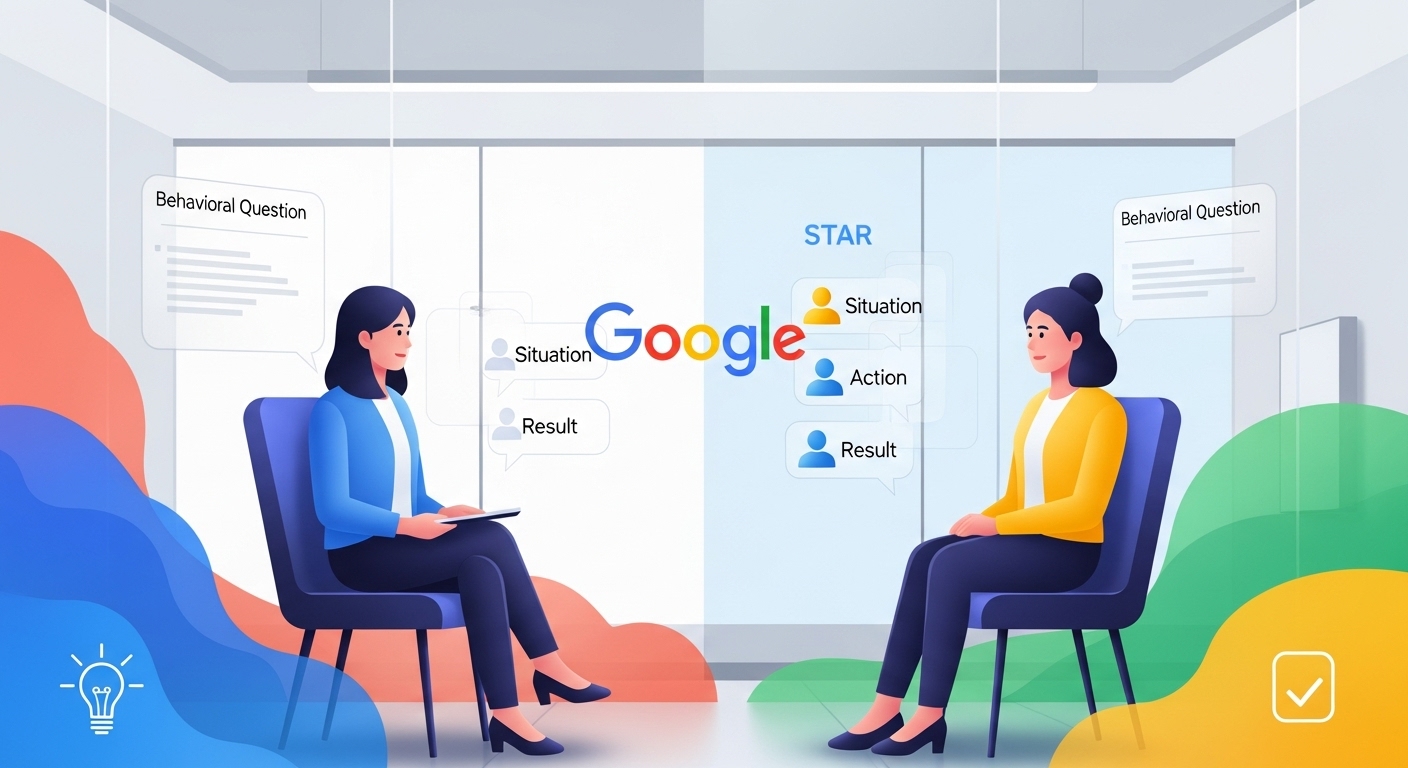
While the STAR method (Situation, Task, Action, Result) is universal, Google interviews require specific adaptations:
Situation (15-20% of your answer)
- Set context concisely—Google values efficiency
- Include relevant metrics: team size, timeline, budget, scale
- Frame the complexity level to show appropriate challenge
Task (10-15% of your answer)
- Clarify your specific role vs. team responsibilities
- Highlight any constraints or ambiguity you navigated
- Show strategic thinking in defining success criteria
Action (50-60% of your answer)
- Use "I" not "we"—Google wants to know YOUR contributions
- Break down your approach into 3-4 clear steps
- Demonstrate data-driven decision making
- Show how you collaborated and influenced others
- Highlight any innovative or unconventional solutions
Result (15-20% of your answer)
- Quantify impact with specific metrics
- Include both immediate and long-term outcomes
- Mention what you learned and how you've applied it since
- If relevant, explain how the solution scaled or influenced others
Sample Google-Ready STAR Answer
Question: "Tell me about a time you led a project from start to finish."
Situation: "At my previous company, our customer support team was overwhelmed with 500+ tickets per day, leading to 48-hour response times and declining CSAT scores that dropped from 85% to 72% over three months."
Task: "I was asked to lead an initiative to reduce response times by 50% within Q2 while maintaining quality. I had no formal authority over the support team and a limited budget of $15K."
Action: "First, I analyzed ticket data and discovered 60% were repetitive questions that could be automated. I proposed a three-part solution: 1) Built a knowledge base with the top 50 FAQs using existing documentation, 2) Implemented a chatbot using open-source tools to handle tier-1 questions, 3) Created a ticket routing system based on urgency and complexity. I got buy-in by presenting data showing potential time savings to the support team lead and demonstrating an MVP chatbot I built over a weekend. I collaborated with engineering to integrate the chatbot, trained the team on the new routing system, and iterated based on their feedback for two weeks."
Result: "Within two months, average response time dropped from 48 hours to 18 hours—a 62% improvement. The chatbot handled 45% of tickets automatically, freeing the team to focus on complex issues. CSAT scores recovered to 82%, and the solution cost only $8K. The system is still in use today, and the framework I created was adopted by two other departments. This taught me the power of data analysis before solution design and the importance of building quick MVPs to demonstrate value."
Practicing for Your Google Interview?
WiseWhisper gives you live AI feedback during mock interviews—structured STAR responses tailored to Google's behavioral questions and culture.
Start FreeGoogle-Specific Interview Tips
1. Demonstrate Googleyness
- Show comfort with ambiguity and changing requirements
- Emphasize collaborative wins over individual achievements
- Highlight examples of helping others succeed
- Discuss learning from diverse perspectives
2. Emphasize Data-Driven Thinking
- Always include metrics in your examples
- Explain how you measured success
- Describe A/B tests or experiments you've run
- Show how data influenced your decisions
3. Show Scale & Impact Thinking
- Discuss how your solutions could scale beyond the immediate problem
- Mention if your work influenced org-wide changes
- Highlight multiplier effects—how you enabled others
4. Prepare Multiple Examples Per Category
- Leadership: 3-4 diverse examples
- Problem-solving: 3-4 technical and non-technical examples
- Teamwork/conflict: 2-3 examples
- Failure/learning: 2 strong examples
Common Mistakes to Avoid
- Using "we" excessively: Google needs to understand YOUR specific contributions. Use "I" to describe your actions.
- Lack of metrics: Vague results like "improved performance" don't demonstrate impact. Quantify everything.
- Rambling answers: Keep answers to 2-3 minutes. Practice concise storytelling.
- Not addressing the question: Listen carefully and answer what's actually asked, not what you wish was asked.
- Overly rehearsed responses: Sound natural, not scripted. Adapt examples to the specific question.
- Blaming others: Even in conflict examples, show empathy and focus on solutions, not fault.
How to Prepare Effectively
1. Build Your Example Bank (2-3 weeks before)
- Review past projects and identify 10-12 strong examples
- Write out full STAR stories with metrics
- Ensure examples cover all major behavioral categories
- Include recent examples (within 2-3 years)
2. Practice Out Loud (1-2 weeks before)
- Record yourself answering sample questions
- Time your responses (aim for 2-3 minutes)
- Get feedback from peers or mentors
- Practice adapting the same example to different questions
3. Research Google Culture (ongoing)
- Read Google's "How We Hire" documentation
- Watch employee videos and blog posts
- Understand the team you're interviewing for
- Connect with current Googlers on LinkedIn
4. Mock Interviews (final week)
- Conduct 2-3 full mock behavioral interviews
- Use WiseWhisper AI for real-time feedback
- Practice handling follow-up questions
- Refine your weakest examples
What to Expect During the Interview
Interview Structure:
- 45-60 minute sessions
- 4-5 behavioral questions typically asked
- Deep follow-up questions to probe your thinking
- Time for your questions at the end (always prepare 2-3 thoughtful questions)
Interviewer Types:
- Hiring manager: Assesses team fit and role alignment
- Peer interviews: Evaluate collaboration and technical approach
- Cross-functional partners: Test stakeholder management
- Senior leaders: Assess strategic thinking and impact
Final Preparation Checklist
- ✓ 10-12 STAR examples prepared across all categories
- ✓ All examples include specific metrics and outcomes
- ✓ Practiced answering out loud at least 5 times per example
- ✓ Researched the specific team and read recent Google news
- ✓ Prepared 3-5 thoughtful questions about the role and team
- ✓ Completed 2-3 full mock interviews
- ✓ Set up WiseWhisper AI for real-time interview support
Master Google Interviews with AI Coaching
WiseWhisper AI listens to your interviewer's behavioral questions and provides instant, Google-optimized STAR responses tailored to their culture and values. Practice unlimited scenarios and get real-time feedback to perfect your interview technique.
Start Your Free Trial TodayConclusion
Success in Google's behavioral interviews requires strategic preparation, structured storytelling, and authentic demonstration of Google's core values. Focus on quantifiable impact, collaborative leadership, and continuous learning. With proper preparation using the STAR method and real-time AI coaching, you'll walk into your Google interview confident and ready to showcase your best work.
Remember: Google is looking for people who can solve complex problems, lead without authority, embrace ambiguity, and make a measurable impact at scale. Every answer should reinforce these qualities.
What Our Users Say
My interview went really well today and mostly because of you!
I truly appreciate the platform and its role in helping users prepare for interviews.
WiseWhisper gave me the confidence I needed during my technical interviews. The real-time suggestions were spot-on and helped me actually get the job!
Using WiseWhisper to practice before my interviews gave me so much more confidence. I felt prepared and ready to tackle any question!
I used to get so anxious before interviews, but WiseWhisper completely changed that. Knowing I had AI support calmed my nerves and helped me perform at my best.
WiseWhisper is a game changer for the unfair job market. It truly helped me succeed in my interview. If I have any interviews in the near future, I will definitely subscribe again!