February 24, 2026 • 12 min read
The difference between a mediocre interview and a stellar one isn't talent—it's practice. But not just any practice. Most people rehearse answers in their head, maybe run through a few questions with a friend, and call it preparation. That's not enough.
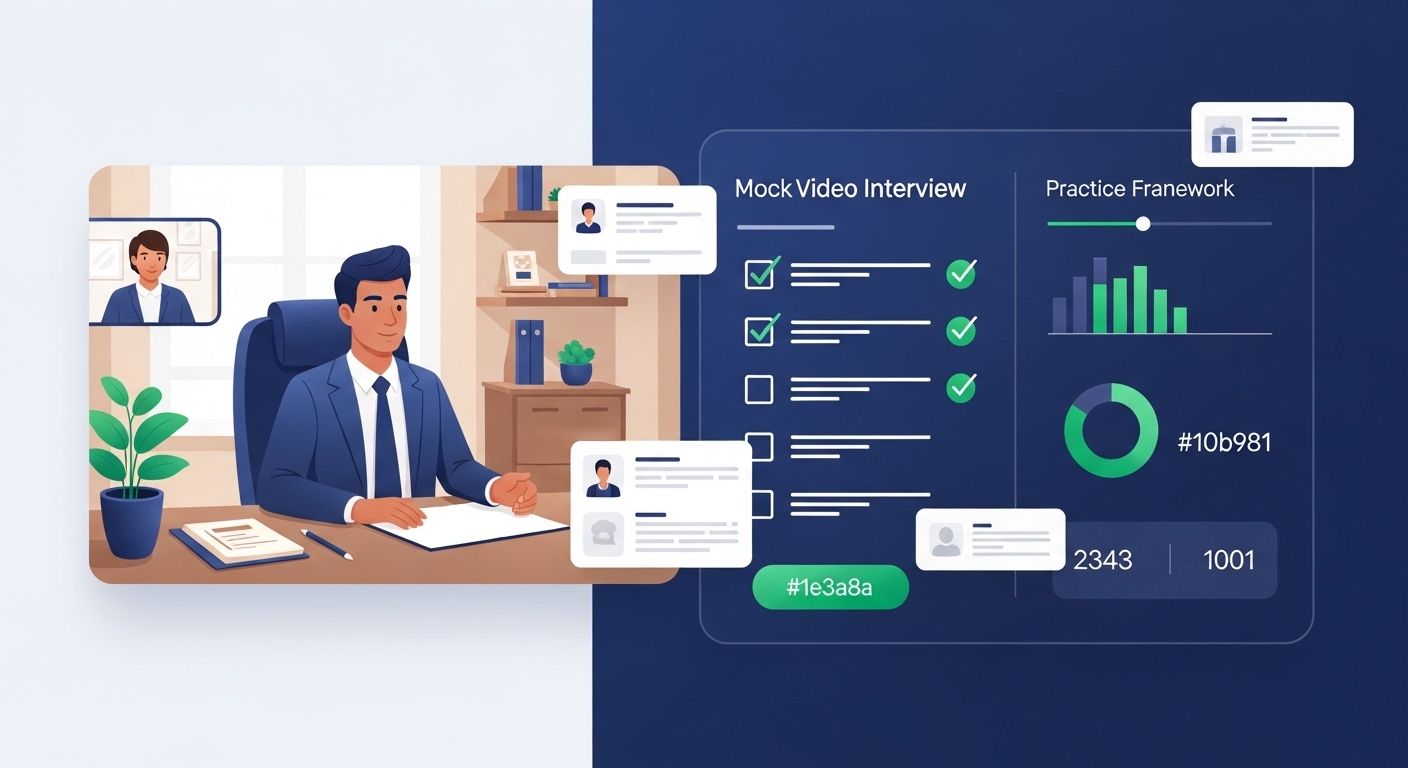
To truly excel, you need to practice like it's the real thing. That means simulating actual interview conditions, measuring your performance objectively, and iterating until excellence becomes automatic. This guide provides a complete framework for conducting effective mock interviews, complete with a free checklist and scoring system.
Why Mock Interviews Actually Work (When Done Right)
Mock interviews work because they activate the same cognitive and emotional systems as real interviews. When you simulate authentic interview conditions, you:
- Build muscle memory for structured responses (STAR method, problem-solving frameworks)
- Reduce anxiety through exposure therapy—the more you practice under pressure, the less stressful real interviews become
- Identify gaps in your preparation before they cost you job offers
- Develop recovery skills for handling unexpected questions or technical difficulties
- Calibrate your pacing to avoid rushed or rambling answers
But here's the catch: only realistic practice produces real results. Casual run-throughs don't create the pressure conditions that trigger performance improvement. You need structured simulation.
Ready to Transform Your Interview Performance?
WiseWhisper provides real-time AI assistance during actual interviews, giving you instant, intelligent responses to any question. It's like having an expert coach in your ear during the interview itself.
Try WiseWhisper NowThe Complete Mock Interview Framework
Effective mock interview practice follows three phases: Preparation, Execution, and Evaluation. Here's the complete framework:
Phase 1: Preparation (Before You Start)
Don't just wing it. Proper setup determines whether your mock interview actually simulates real conditions.
✓ Mock Interview Preparation Checklist
Pro tip: Schedule your mock interview at least 3-5 days before your real interview. This gives you time to incorporate feedback without scrambling at the last minute.
Phase 2: Execution (During the Mock Interview)
Treat this like the actual interview. No do-overs, no pauses, no casual conversation beforehand. Start the video call, begin the interview, and commit to the simulation.
✓ Mock Interview Execution Checklist
Important: If you stumble or give a weak answer, don't stop to redo it. Practice recovering gracefully—that's a critical interview skill.
Phase 3: Evaluation (The Scoring System)
This is where most people fail. They finish the mock interview, hear some generic feedback ("that was good!"), and move on without truly measuring performance. Don't make that mistake.
Use this objective scoring system to evaluate your mock interview performance. Rate yourself (or have your interviewer rate you) on a 1-5 scale for each category:
🎯 Mock Interview Scoring System
1. First Impression & Presence (1-5)
- Professional appearance and background
- Confident body language and posture
- Strong opening and small talk
- Energy and enthusiasm level
2. Communication Clarity (1-5)
- Clear, well-paced speaking (not too fast or slow)
- Minimal filler words ("um," "like," "you know")
- Concise answers without rambling
- Good use of pauses and inflection
3. Content Quality (1-5)
- Specific, detailed examples (not vague generalities)
- Quantifiable results and achievements
- Relevant experience matched to job requirements
- Demonstrates skills clearly
4. Structure & Organization (1-5)
- Uses STAR or other frameworks consistently
- Logical flow from setup to conclusion
- Stays on topic without tangents
- Answers the question fully
5. Technical Accuracy (1-5)
- Correct terminology and concepts
- Demonstrates deep knowledge (not surface-level)
- Handles technical questions confidently
- Admits knowledge gaps honestly when needed
6. Behavioral Questions (1-5)
- Provides complete STAR stories
- Shows problem-solving and critical thinking
- Demonstrates leadership or collaboration
- Highlights learning and growth
7. Recovery & Adaptability (1-5)
- Handles unexpected questions smoothly
- Recovers from mistakes without panic
- Adapts communication style to interviewer
- Manages technical difficulties professionally
8. Questions & Closing (1-5)
- Asks thoughtful, researched questions
- Shows genuine interest in role and company
- Professional closing and thank you
- Clarifies next steps appropriately
Total Score: _____ / 40
35-40: Excellent—ready for high-stakes interviews
28-34: Good—minor improvements needed
20-27: Fair—more practice required
Below 20: Needs significant work—run multiple mock interviews
Common Mock Interview Mistakes (And How to Fix Them)
Mistake 1: Not Taking It Seriously
If you laugh off mistakes, skip questions, or treat the mock interview casually, you're wasting your time. Your brain needs to believe the stakes are real to activate performance-enhancing stress hormones.
Fix: Schedule it formally. Dress up. Set consequences—if you score below 30/40, you owe yourself another mock interview within 48 hours.
Mistake 2: Using the Same Mock Interviewer Every Time
Different interviewers have different styles. If you only practice with one person, you're not preparing for the variety you'll encounter in real interviews.
Fix: Rotate mock interviewers. Practice with someone aggressive, someone soft-spoken, someone technical, someone behavioral-focused.
Mistake 3: Not Reviewing the Recording
Watching yourself on video is uncomfortable. That's precisely why it's so valuable. You'll notice body language tics, filler words, and pacing issues you never realized you had.
Fix: Force yourself to watch the entire recording within 24 hours. Take notes on specific improvements.
Mistake 4: Practicing Only "Easy" Questions
If you only practice questions you're comfortable with, you'll be blindsided by curveballs in the real interview.
Fix: Give your mock interviewer permission to ask hard questions. Include questions about weaknesses, gaps in your resume, and challenges you've faced.
Take Your Interview Prep to the Next Level
Mock interviews prepare you for practice scenarios. But what about the real interview? That's where WiseWhisper comes in.
WiseWhisper provides real-time AI assistance during actual interviews, giving you instant, intelligent responses to any question. It's like having an expert coach in your ear during the interview itself—ensuring you never freeze, stumble, or miss an opportunity to showcase your qualifications.
Advanced Mock Interview Techniques
1. The "Stress Test" Mock Interview
Have your mock interviewer intentionally create difficult conditions:
- Interrupt you mid-answer
- Ask rapid-fire questions without pause
- Challenge your answers skeptically
- Simulate technical difficulties (mute themselves, freeze video)
This builds resilience and prepares you for worst-case scenarios.
2. The "Silent Feedback" Method
After the mock interview, don't discuss it immediately. First, score yourself using the rubric above. Then, have your interviewer score you separately. Compare scores and discuss discrepancies. This reveals blind spots—areas where your self-perception doesn't match external reality.
3. The "Industry Insider" Mock Interview
If possible, find someone who works in your target industry or company to conduct your mock interview. They'll ask questions you won't find in generic lists and provide insights about what the company actually values.
How Many Mock Interviews Do You Need?
The magic number: at least three.
- Mock Interview 1: Baseline assessment—you'll be rough, and that's fine
- Mock Interview 2: Incorporate feedback from the first session, focus on fixing major weaknesses
- Mock Interview 3: Polish performance, build confidence, simulate final conditions
For high-stakes roles (executive positions, competitive tech jobs, career pivots), consider 5-7 mock interviews with different people.
Final Checklist: Are You Ready for the Real Thing?
Before your actual interview, verify that you can confidently answer "yes" to these questions:
If you answered "yes" to all of these, you're ready. If not, schedule another mock interview and work on the gaps.
The Ultimate Safety Net: Real-Time Interview Assistance
Mock interviews dramatically improve your performance—but they can't eliminate all interview uncertainty. You'll still face unexpected questions, unfamiliar scenarios, and moments where your preparation doesn't quite cover what the interviewer is asking.
That's where WiseWhisper becomes invaluable. While mock interviews prepare you for expected situations, WiseWhisper handles the unexpected ones—in real-time, during your actual interview.
How it works: WiseWhisper listens to interview questions as they're asked and instantly provides intelligent, structured responses on your screen. You adapt the suggestions to your style and deliver confident answers—even to questions you didn't prepare for.
Think of it as your backup plan. Mock interviews train you for the 80% you can anticipate. WiseWhisper covers the 20% you can't.
What Our Users Say
My interview went really well today and mostly because of you!
I truly appreciate the platform and its role in helping users prepare for interviews.
WiseWhisper gave me the confidence I needed during my technical interviews. The real-time suggestions were spot-on and helped me actually get the job!
Using WiseWhisper to practice before my interviews gave me so much more confidence. I felt prepared and ready to tackle any question!
I used to get so anxious before interviews, but WiseWhisper completely changed that. Knowing I had AI support calmed my nerves and helped me perform at my best.
WiseWhisper is a game changer for the unfair job market. It truly helped me succeed in my interview. If I have any interviews in the near future, I will definitely subscribe again!